Octree Ray Tracing - Aukio 3D
Table of Contents
1. What the octree adds
The raster pipeline draws triangles. The renderer/octree package
offers a second, independent way to build a scene: a voxel volume.
Space is stored as an octree — a tree that recursively subdivides a
cube into eight octants — which compresses sparse or repetitive
volumes well: empty regions are never allocated, and a solid room
wall can stay one large cell until something forces it to split.
On top of that volume, renderer/octree/raytracer implements a real
ray tracer: it casts one ray per pixel through the octree, finds
the first occupied voxel, and computes lighting by casting shadow
rays from the hit point toward every light source. The ray tracer is
a rendering curiosity next to the raster pipeline — but it is a
complete one, with per-pixel shadows and progressive on-screen
refinement.
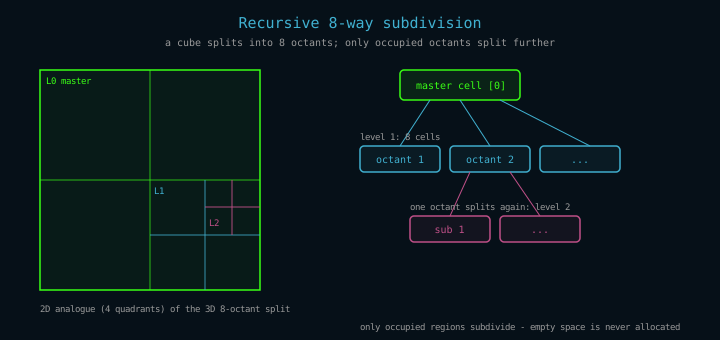
Figure 1: Left: the 2D analogue of recursive subdivision — only occupied regions split. Right: the same as a tree. Empty space costs no cells.
2. The data structure: a flat cell pool
OctreeVolume stores the whole tree in a flat pool: eight parallel
int arrays (cell1 … cell8), and a cell is just an index into
them. The packing is economical:
- a solid leaf uses
cell1for its state marker,cell2for its color andcell3for its illumination value; - an internal cell uses all eight arrays as child pointers —
breakSolidCellsubdivides a leaf by writing eight freshly allocated children intocell1…cell8, inheriting the parent's color and illumination.
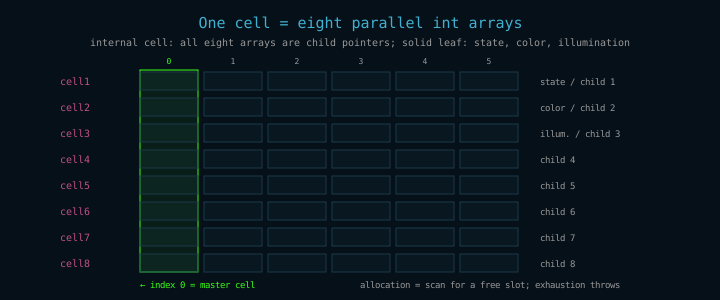
Figure 2: The flat cell pool. Index 0 is the master cell covering the whole world. Allocation scans for a free slot with wraparound; when the pool is full, allocation throws IllegalStateException (grow the pool at initWorld or reduce voxel density).
There are no Java objects per cell and no pointers to chase beyond
array indexing — the same cache-friendly layout philosophy as the
raster pipeline's mesh blocks. Cell zero is the master cell, whose
edge length is masterCellSize world units.
Building a volume is incremental:
OctreeVolume volume = new OctreeVolume();
volume.initWorld(poolSize, masterCellSize);

// single voxel:
volume.putCell(x, y, z, color);

// filled box of voxels:
volume.fillRectangle(new IntegerPoint(x1, y1, z1),
                     new IntegerPoint(x2, y2, z2), color);
3. Ray tracing through the volume
RayTracer is constructed with a target Texture, the volume, the
light list and a RaytracingCamera (which wraps the scene's raster
camera plus a magnification factor, and owns the texture the result
is painted into). It implements Runnable — the demo runs it on a
plain background thread:
RaytracingCamera rtCamera = new RaytracingCamera(viewPanel.getCamera(), magnification);
RayTracer rayTracer = new RayTracer(rtCamera.getTexture(),
                                    octreeVolume, lights, rtCamera, viewPanel);
new Thread(rayTracer).start();
For each pixel, RaytracingCamera generates a Ray; traversal
(OctreeVolume.traceCell) descends the hierarchy, testing only the
children a ray actually crosses and skipping empty subtrees entirely
— empty space is never touched voxel by voxel. The first occupied
cell hit yields the surface point and its cell2 color.
Lighting is per-pixel: from the hit point a shadow ray is cast
toward every LightSource. If any occupied cell blocks that ray,
the point is in shadow for that light; otherwise the light
contributes to the pixel.
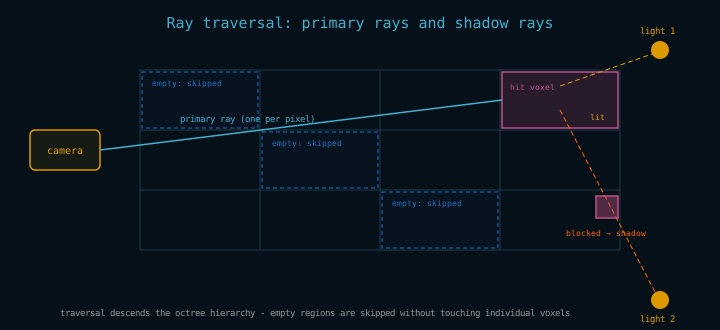
Figure 3: A primary ray crosses the volume (empty cells are skipped wholesale), hits an occupied voxel, and shadow rays decide per-light visibility. Light 2 is blocked, so its contribution is shadowed.
The render is progressive: the tracer repaints its texture roughly
once per second (PROGRESS_UPDATE_FREQUENCY_MILLIS), so a refining
image appears immediately and sharpens as more pixels complete — you
watch the shadows settle rather than waiting for a final image.
4. Trying it out
The Octree demo in the aukio-3d-demos project
(examples/OctreeDemo.java) builds a voxel scene (spiral, tiled
floor, a fractal) into an OctreeVolume, places light sources, and
starts a background ray-trace render of the current view. The same
scene builds deterministically for the golden-image harness, so the
ray-traced output is regression-tested like every other demo.